- MOH License No. 1539/2/5/14/5/15 · Villa 823 - شارع شاطئ جميرة - Umm Suqeim Third - Umm Suqeim 3 - Dubai

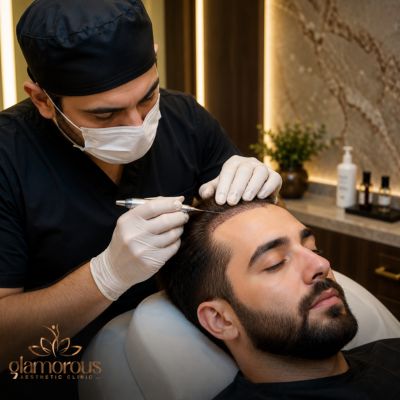
A Male Hair Transplant in Dubai relocates permanent, DHT-resistant hair follicles from the back and sides of your scalp into thinning or bald areas at the hairline and crown. At Glam Clinic Dubai, Dr. Hamid Ali Esmaeilpour performs every male hair transplant using FUE and DHI, planning graft placement around your specific Norwood stage, donor supply, and hairline goals rather than applying a generic template.
Quick Facts:
- Procedure time: 3–8 hours, depending on graft count
- Anesthesia: Local anesthesia
- Techniques offered: FUE, DHI, robotic-assisted extraction
- Downtime: Back to work in 3–5 days
- First visible growth: 3–4 months
- Full results: 12–18 months
- Cost: From AED 6,999
- Lead surgeon: Dr. Hamid Ali Esmaeilpour
What Is a Male Hair Transplant?
A male hair transplant is a surgical procedure that moves individual hair follicles from a genetically resistant donor zone — typically the back and sides of the scalp — into areas affected by male pattern baldness. Because these donor follicles are naturally resistant to the DHT hormone responsible for pattern baldness, they continue growing normally once relocated, which is what makes transplant results permanent rather than temporary.
Results of Male Hair Transplant in Dubai:
- Permanent, natural-looking coverage using hormone-resistant donor follicles
- Most patients see 80–90% growth by month 12, with final results settling by month 18
- Results planned around your specific hairline shape, temple points, and crown pattern
Why Choose Dr. Hamid Ali Esmaeilpour?
- Norwood-stage-specific planning, since graft distribution differs significantly between a receding hairline and full crown involvement
- Natural hairline design matched to age and face shape (see our natural hairline page for detail)
- DHA-licensed facility with sterile, standardized surgical protocols
- Options across FUE, DHI, and robotic-assisted extraction
What are the common causes of male hair loss?
| Cause | Presentation | Treatable With Transplant? |
| Androgenetic alopecia | Receding hairline, crown thinning | Yes, once stabilized |
| Alopecia areata | Patchy, sudden loss | Only once stable and inactive |
| Telogen effluvium | Diffuse, stress-related shedding | Usually resolves without surgery |
| Traction alopecia | Hairline thinning from tight styling | Yes, if donor supply allows |
What are the different male hair transplant techniques?
FUE
Individual follicle extraction with tiny, virtually invisible scarring — the most versatile technique for most male patients. See our full breakdown on the FUE hair transplant page.
DHI
Direct implantation for tighter angle and density control, often used for hairline and crown precision work. See the DHI hair transplant page.
Robotic-Assisted FUE
Image-guided extraction for larger sessions requiring high graft consistency. Details on our robotic hair transplant page.
Am I a Good Candidate?
Good candidates for a male hair transplant typically have:
- Norwood stage 3 or beyond, with stabilized hair loss
- Sufficient donor density at the back and sides
- Realistic expectations about graft count needed for full coverage
A transplant may not be ideal if you have:
- Very early-stage thinning better suited to PRP or medication first
- Insufficient donor supply for the area needing coverage
- Actively progressing, unevaluated hair loss
What is the process step by step?
- Consultation – Norwood staging, donor assessment, and hairline design.
- Preparation – local anesthesia administered, recipient sites marked.
- Extraction – follicles harvested via FUE, DHI, or robotic-assisted method.
- Implantation – grafts placed to match natural density and direction.
- Aftercare briefing – written recovery plan provided.
What is the recovery timeline after treatment?
| Period | What to Expect | Care |
| Days 1–3 | Mild swelling, redness, tiny scabs | Sleep at a 45° angle |
| Week 1–2 | Scabs shed, some shock loss (normal) | Gentle shampooing only |
| Months 3–6 | Visible new growth (30–50% density) | Normal styling resumes |
| Months 12–18 | Final, full density | Natural, permanent results |
How much does a male hair transplant cost in Dubai?
| Technique | Approx. Price Range (AED) | Typical Graft Count |
| FUE | 6,999 – 20,000 | 1,500–3,500 |
| DHI | 15,000 – 26,000 | 1,200–2,500 |
| Robotic | 12,999 – 28,000 | 1,500–3,500 |
What are the differences between male hair transplants and other options?
| Option | Permanence | Best For |
| Male hair transplant (FUE/DHI) | Permanent | Established baldness, Norwood 3+ |
| PRP | Temporary, needs maintenance | Early thinning, boosting transplant results |
| Scalp micropigmentation | Cosmetic illusion only | Non-surgical density appearance |
Pros: Permanent results, hormone-resistant donor hair, wide range of technique options. Cons: Requires 12+ months for full results; not ideal for very early-stage or actively unstable hair loss.
Frequently Asked Questions:
Is a Male Hair Transplant Permanent?
Yes, because donor follicles from the back and sides are genetically resistant to the hormone that causes pattern baldness, they continue growing permanently once transplanted.
What's the Best Age for a Male Hair Transplant?
There's no single ideal age, but most surgeons prefer to wait until a patient's hair loss pattern has stabilized enough to plan an accurate, long-lasting design.
How Much Does a Male Hair Transplant Cost in Dubai?
Pricing starts from AED 6,999 and depends on technique and graft count — you'll get an exact quote after your consultation.
Will I Need More Than One Session?
Most men achieve their goals in a single session, though those with extensive baldness or limited donor supply may benefit from a staged second session later.
Does a Male Hair Transplant Hurt?
The procedure is performed under local anesthesia, so discomfort during the transplant itself is minimal.
Can I Combine a Transplant With Medication?
Yes, many patients continue medication after a transplant to help protect surrounding native hair from further loss.
How Soon Can I Return to the Gym?
Most patients can resume light exercise within 1-2 weeks, though heavy sweating and swimming should be avoided for at least 3-4 weeks.
Will My Transplant Look Obvious to Others?
Not when planned properly — natural hairline design and gradual density placement are specifically intended to make results undetectable as a transplant.
What If I Continue Losing Native Hair After the Transplant?
This is common with progressive androgenetic alopecia, which is why many patients pair their transplant with ongoing PRP or medication to protect non-transplanted areas.
Book Your Free Consultation
Book a free consultation with Dr. Hamid Ali Esmaeilpour for a personalized graft estimate and technique recommendation.
Related treatments: Hair Transplant Dubai · Baldness Treatment for Men · FUE Hair Transplant · DHI Hair Transplant · Crown Hair Transplant