- MOH License No. 1539/2/5/14/5/15 · Villa 823 - شارع شاطئ جميرة - Umm Suqeim Third - Umm Suqeim 3 - Dubai

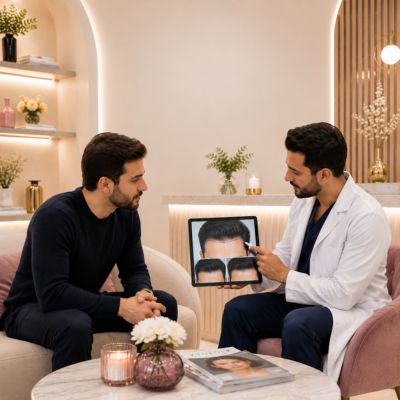
A Natural Hairline in Dubai is a designed to match your individual face shape, age, and native hair growth pattern, rather than a generic straight edge that looks obviously transplanted. At Glam Clinic Dubai, Dr. Hamid Ali Esmaeilpour treats hairline design as the single most important planning decision in any hair transplant, since it’s the one detail people notice first — and the hardest one to fix afterward.
Quick Facts:
- Planning stage: Included with every hair transplant consultation
- Design factors: Face shape, age, native hair direction, temple points
- Techniques used: FUE, DHI
- Result: Irregular, soft frontal edge — not a straight line
- Lead surgeon: Dr. Hamid Ali Esmaeilpour
What Makes a Hairline Look Natural?
A natural hairline is irregular, not straight — it has soft, slightly uneven density at the front edge, follows the natural curve of the head, and is positioned in proportion to the rest of the face. The most common giveaway of a poorly planned transplant isn’t low density; it’s a hairline drawn too low, too straight, or too symmetrical for the patient’s age and face shape.
Why Hairline Design Matters More Than Graft Count
Hairline design determines how natural your entire result looks, regardless of how many grafts are used, because it’s the frame the eye reads first. Two patients can receive the same graft count and technique and end up with completely different-looking results depending on how the frontal hairline was planned — proportion and irregularity matter more here than raw density.
Why Choose Dr. Hamid Ali Esmaeilpour for Hairline Design?
- Facial proportion mapping based on your bone structure and age, not a fixed template
- Irregular hairline placement that mimics natural, non-uniform hair growth
- Temple point restoration to soften the transition between hairline and sides
- Applied consistently across FUE and DHI procedures
The Elements of Natural Hairline Design
- Age-appropriate positioning — a hairline set too low for an older patient reads as unnatural, even if density is good
- Irregular front edge — natural hairlines have small variations in density and shape, not a ruler-straight line
- Correct hair direction — frontal grafts are angled forward and slightly downward, not straight up
- Temple point recreation — restoring the natural recession points at the temples, rather than filling them in completely
- Density gradient — higher density behind the front edge, gradually thinning toward the very front line
Common Hairline Design Mistakes
- Drawing the hairline too low, especially in younger patients whose hairline will naturally recede further with age
- Using a perfectly straight or symmetrical line instead of natural irregularity
- Ignoring temple point recession, leading to a “helmet” look
- Placing frontal grafts at the wrong angle, causing hair to stand up rather than lie forward naturally
How Hairline Design Fits Into Your Transplant
Hairline design happens during your consultation, before any grafts are extracted — Dr. Hamid Ali Esmaeilpour marks the proposed hairline on your scalp so you can see and approve the shape before the procedure begins. This planning step applies whether you’re having FUE, DHI, or a crown hair transplant that also involves frontal work.
Frequently Asked Questions:
Can a Hairline Be Fixed If It Was Done Wrong?
In some cases, yes — additional grafts can soften an overly straight or too-low hairline, though correcting a poorly planned hairline is generally more complex than getting it right the first time.
Do I Get to See the Hairline Design Before Surgery?
Yes. Dr. Hamid Ali Esmaeilpour marks the proposed hairline directly on your scalp during consultation so you can review and approve the shape before any grafts are extracted.
Book Your consultation:
Book a free consultation to see your personalized hairline design plan before committing to a procedure.
Related treatments: Hair Transplant Dubai · FUE Hair Transplant · DHI Hair Transplant · Crown Hair Transplant